
P.O Box 863, Lafayette, CO 80026
Regulatory ReportingColoradoECMC Form 44 Flowline Registration

ECMC Form 44 Flowline Registration

By: Stephany Olsen | Last updated: October 14, 2026

A strong ECMC Form 44 registration is complete, internally consistent, and technically defensible. The pressure test, GIS alignment, and technical attributes should all tell the same story, and the operator should choose deliberately whether to register lines by end point or as a flowline system, because that choice governs every Form 44 filed for those lines afterward.

What is ECMC Form 44?

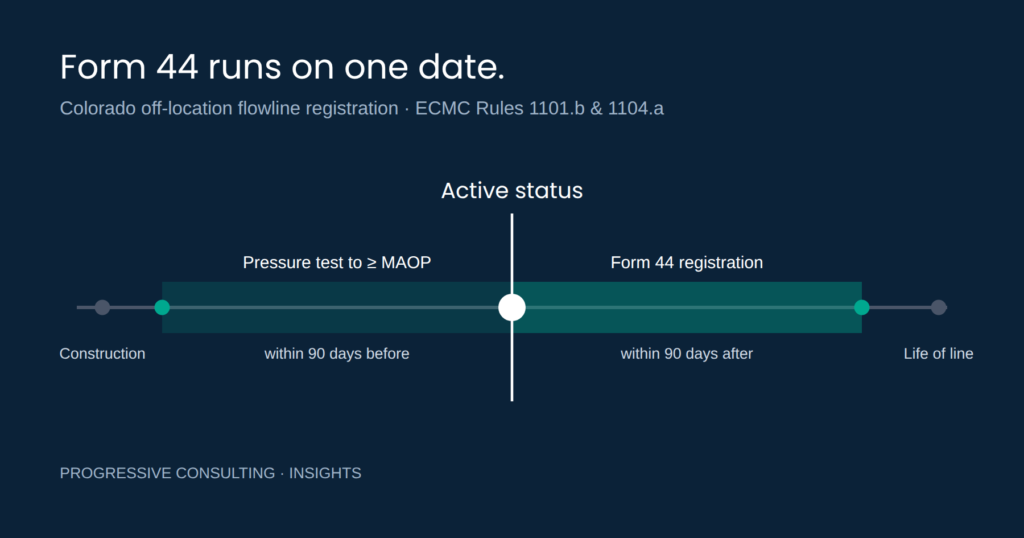
Form 44 is the Flowline Report the Colorado Energy & Carbon Management Commission (ECMC) uses to register off-location flowlines. Under Rule 1101.b, an operator must register every off-location flowline, by end point location or as part of a flowline system, within 90 days after it is placed in active status. On-location flowlines do not require registration. For more on which lines need registering, see Streamlining Flowline Compliance.

What does a weak Form 44 registration cost an operator?

The cost of a weak Form 44 registration shows up in future work. The registration has to be approved before subsequent reports on those lines can be submitted, so a package that comes back for revision can delay planned fieldwork, disrupt crew scheduling, and pull staff back into additional review cycles.

There is also compliance exposure, because ECMC is not required to review registrations within a set time frame. If a mistake is made and the form is not reviewed for multiple years, it can be extremely difficult for an operator to correct the mistake or have appropriate internal records to address ECMC concerns.

A weak package also leaves errors in the public record. Once approved, Form 44 data feeds the ECMC map viewer and Scout Cards, where the flowline's location, fluid type, pipe material, and size are visible to landowners, excavators, and local governments. A well-prepared registration keeps that record accurate and makes every later filing on the line easier.

Why do Colorado flowline filings face more scrutiny than they used to?

Colorado's flowline framework has been rewritten twice in recent years. The 1100 Series was overhauled in 2018 and amended again in rules effective January 15, 2021. The current rules put more weight on flowline integrity and on how lines are retired.

  • Pressure testing. Rule 1104.a requires a newly installed segment to be tested to at least maximum anticipated operating pressure (MAOP) within 90 days before it goes active. Testing is also required at other points in the line's life, and test results draw close review.
  • Abandonment. The agency expectation is that flowlines will be removed at abandonment. Rule 1105.d.(2) allows operators to request abandonment in place only under listed exceptions, such as a surface owner agreement or co-location with other active lines.
  • Integrity management. Rule 1104 outlines eleven different scenarios where operators are expected to perform routine field maintenance, maintain records, and sometimes report evidence of flowline integrity. Operators are expected not only to remain in compliance for each line, but also to have a robust program that is included with the initial registration.
Timeline showing the ECMC Form 44 window: pressure test to at least MAOP within 90 days before a flowline goes active, and Form 44 registration within 90 days after.

What does a strong Form 44 submittal package look like?

A strong Form 44 shows three qualities: consistency, completeness, and technical defensibility. Every exhibit should describe the same line, and the package should document the work that was actually performed in the field.

Package elementWhat it must showRule
GIS dataAs-built alignment in NAD 83, with fluid type, pipe material, and pipe size attributes1101.b
Technical attributesFlowline type, fluids transferred, pipe material, bedding material, diameter, MAOP1101.b
Pressure testInitial test to at least MAOP, within 90 days before active status1104.a
Integrity managementHow the operator monitors and maintains the line1104.f
Construction methodsMethods used in sensitive areas and at watercourse crossings1101.b

End point or system: how should the lines be grouped?

Unlike most ECMC requirements, off-location flowline registration lets the operator decide how lines are grouped for reporting. The technical requirements are identical either way. What changes is how many forms the operator files, how changes are tracked, and how well the registrations fit the operator's own data systems.

Form 44 registration structures at a glance

End point registration

Facility
How it works

All lines that terminate at the same facility share one registration.

Best for
  • A small number of flowlines
  • Lines that run the same direction
  • Infrequent status changes in the field
Watch for
  • Co-located lines running opposite directions need two registrations
  • Lines ending at a tie-in or valve set

System registration

ONE SYSTEM REGISTRATIONField AField BField C
How it works

Lines are grouped under one registration even if they never connect. An operator's entire flowline portfolio, across multiple fields, can sit in a single system.

Best for
  • Lines that belong together; not required to be in physical proximity
  • Large portfolios with frequent changes
  • Operators with strong IT, GIS, and field-change processes
Watch for
  • Needs disciplined internal tracking to stay accurate
  • Harder to switch out of once lines are registered

Applies either way

When it's filed
Within 90 days after the line goes active
Technical attributes
ECMC-approved categories of fluid, material, bedding, and diameter
GIS data
NAD 83; ±3 ft positional accuracy
Pressure test
At least MAOP, within 90 days before active
One Call
Tier One CO 811 membership (Rule 1102.n)

Operators can also mix the two types of registrations. For example, an operator might register wellhead lines by end point and register all produced water lines within a system, so one annual Form 44 covers every produced water change while wellhead lines are handled individually.

Three questions to settle before registering

  1. How complex is the new construction? Decide whether an end point registration fits the layout, or whether opposite-direction lines and tie-ins make a system cleaner.
  2. What systems and structures are already in place internally? A new registration usually works best inside the framework of an operator's existing processes and/or previous registrations.
  3. What will be easiest to maintain? Consider every Form 44 the line will need through the rest of its life, not just the first one. Some operators see a high volume of changes and would rather submit one Form 44 capturing all of them than multiple Form 44s for every change at each end location. Other operators regularly buy and sell assets. Depending on the attributes of the flowlines and the types of acquisitions, either type of registration can make transfers easier to manage.

The choice sticks. Once a line is registered by end point or within a system, subsequent Form 44s follow that structure. Switching later, after an acquisition, a portfolio cleanup, or an internal process change, is possible but takes planning, multiple forms, and clear communication with ECMC.

What are the most common ECMC Form 44 filing errors?

In Progressive's experience preparing and revising Form 44 packages for Colorado operators, the problems that create the most friction in ECMC review are usually straightforward.

Pressure test that doesn't reach MAOP

The initial test must reach at least the maximum anticipated operating pressure reported on the form. A lower test pressure contradicts the rest of the package. In addition to MAOP, depending on why a test was conducted, the test duration must meet the requirements laid out in Rule 1104.

Pipe material that doesn't match the fluid

Produced water in steel pipe, for example, without explanation of coating or cathodic protection will be a flag for ECMC, and they will inquire about the integrity management plan.

GIS in the wrong format

Registrations stall when GIS data isn't submitted in ECMC's preferred file type, datum, and attribute structure.

Third-party documents that disagree with the form

Test tickets or contractor reports with typo-level depth or date errors, or missing fields, that contradict the rest of the package will slow down ECMC review and approval.

Questions worth answering before the ECMC asks them for you

  • Is this flowline in active or pre-commissioned status?
  • Is it on-location or off-location?
  • Is it being added to an existing system registration?
  • Does every part of the Form 44, including attachments, describe the same line?
  • Does the as-built GIS data show the actual flowline path within the required positional accuracy?
  • Did the initial pressure test reach at least MAOP, as required by Rule 1104.a?
  • Does the test date make sense against the flowline's active date and the well's first date of production?
  • Are size, route, material, and MAOP records retained as required by Rule 1102.m?
  • Is the operator an active Tier One member of CO 811 under Rule 1102.n?

How long does an operator have to file the Form 44 registration?

90 days after the flowline or flowline system is placed in active status (Rule 1101.b). Lines registered within a produced water transfer system instead follow an annual Form 44 due May 1 when alignments changed during the prior year.

When will the flowline appear on the ECMC map and Scout Cards?

After the Form 44 is approved. ECMC then publishes the line's location, operator, fluid type, pipe material, and pipe size through its public map viewer.

Do on-location flowlines need a Form 44?

No. Form 44 registration applies to off-location flowlines. Certain other lines are also exempt.

Can an operator switch between end point and system registration?

Yes, but it takes planning, multiple forms, and coordination with ECMC, so it's best decided up front.

What happens if an operator finds an off-location flowline that was never registered?

Next steps depend on the situation. Progressive recommends addressing it directly and discussing a path forward with ECMC rather than waiting for it to surface in an inspection.

Getting Form 44 right the first time

A Form 44 registration does more than check a box. It sets the structure every later filing on that line will follow, puts the line's details into the public record, and becomes the baseline ECMC measures the operator against for the rest of the line's life. A package that is consistent, complete, and technically defensible clears review with less friction and makes every later filing easier. One that isn't can sit unreviewed for years before the problems surface, when they are hardest to fix.

Progressive prepares and revises Form 44 registrations for Colorado operators, from single end point registrations to system-wide cleanups after an acquisition. If you're deciding how to structure a new registration, or aren't sure your existing registrations would hold up to review, our Colorado team can help.

Need help with a Form 44 registration or a flowline program?

Talk to our team about new registrations, system restructuring, or a review of what's already on file.

Contact Our Flowline Experts

ELEVATE YOUR BUSINESS WITH

Valiance theme

Limitless customization options & Elementor compatibility let anyone create a beautiful website with Valiance.