By: Aubrey Wood (Noonan)|Last updated: August 18, 2026
The cheapest Form 6 to prepare is rarely the one that receives the least attention — a weak filing costs far more after submittal than it saved before it.
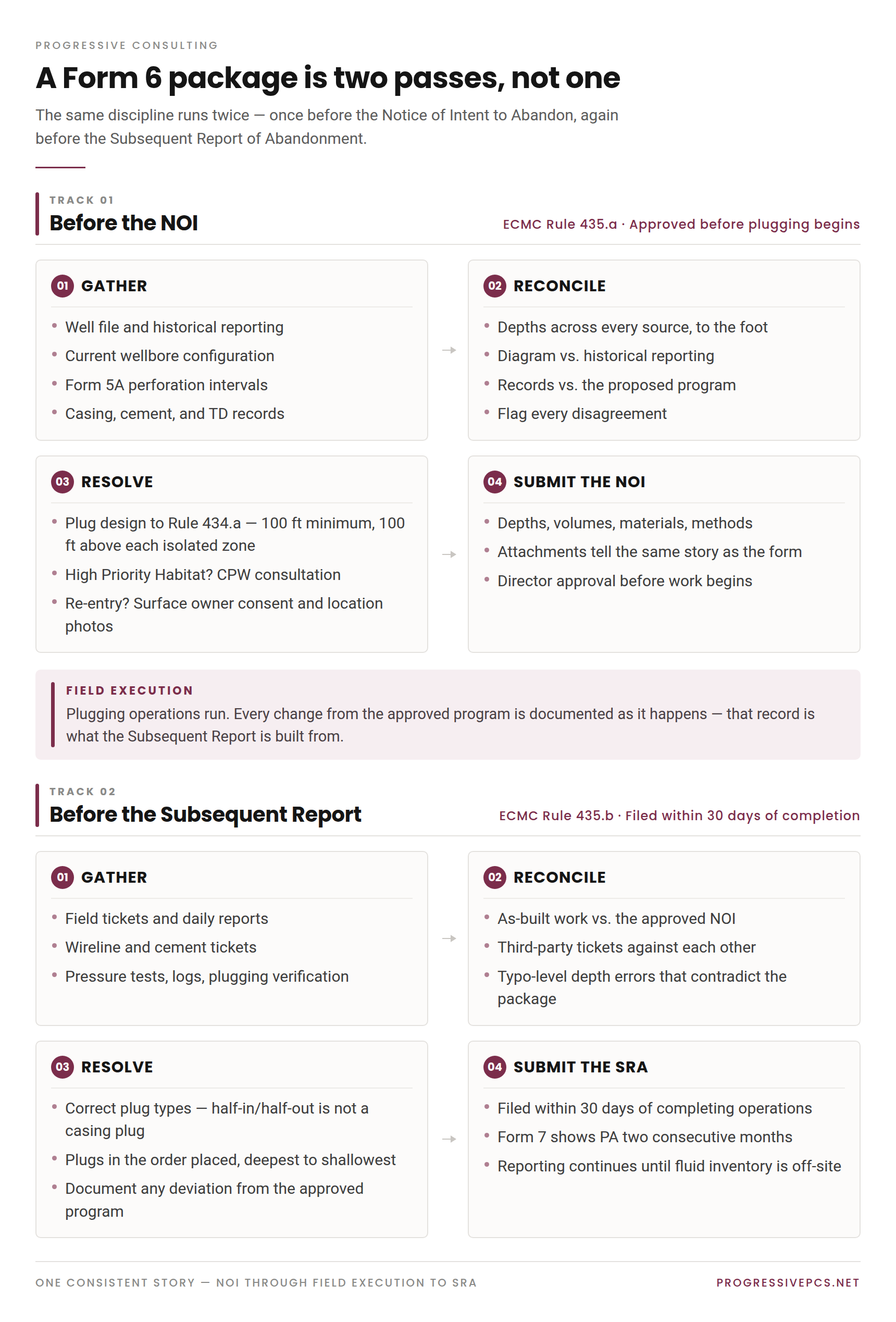
ECMC Form 6 is the well abandonment report required by the Colorado Energy & Carbon Management Commission (ECMC) for plugging and abandoning oil and gas wells in Colorado. It has two parts: the Form 6 – Notice of Intent to Abandon (NOI), which must be submitted and approved by the Director before plugging work begins, and the Form 6 – Subsequent Report of Abandonment (SRA), which must be filed within 30 days after abandonment operations are complete. Under ECMC Rule 435.a, the NOI and its attachments must fully and consistently describe the proposed depths, sizes, volumes, and materials for the abandonment; under Rule 435.b, the SRA must document and verify the work actually performed.
A strong Form 6 package is complete, internally consistent, and technically defensible. A weak package leaves the ECMC reviewer reconciling missing information, conflicting well data, or an abandonment plan that doesn't clearly demonstrate compliance with Colorado's plugging and abandonment requirements.
Why does a weak Form 6 filing cost more than the correction itself?
A returned or revised Form 6 package can delay a planned P&A operation, disrupt rig and contractor scheduling, and require additional engineering or regulatory review. A filing that results in noncompliance creates more serious exposure: ECMC has authority to investigate alleged violations, impose penalties, issue orders, and require corrective action. If deficiencies are not corrected, the Director may issue a corrective action under ECMC Rule 210.
There is also an operational and credibility cost. Repeatedly submitting Form 6 packages that require substantial correction means more staff time, more back-and-forth with the agency, and greater scrutiny of subsequent filings. A well-prepared package reduces uncertainty before the rig arrives and protects the operator's ability to execute its P&A program on schedule.
Why do Colorado P&A filings face more scrutiny than they used to?
Colorado's regulatory framework for plugging and abandonment has evolved significantly. ECMC's recent regulatory changes place greater emphasis on wellbore integrity and groundwater protection. ECMC Rule 434.a requires operators to plug wells in a manner that isolates specific zones, and ECMC reviewers are looking for a package that demonstrates, on its face, that the proposed plugging program achieves that isolation.
What does a strong Form 6 submittal package look like?
A strong Form 6 submittal demonstrates three qualities: consistency, completeness, and technical defensibility.
The proposed plugging procedure in the Form 6 NOI should be consistent with the well's historical records and current wellbore configuration. The Form 6 SRA should then document the work actually performed — including required pressure test results, logs, and plugging verification reports — and demonstrate that the completed work matches the approved plugging procedure. A strong abandonment package maintains this consistency from the NOI through field execution to the final SRA.
Form 6 – NOI
When it's filed
Before plugging begins
What it must show
Full proposed program — depths, volumes, materials
Governing rule
ECMC Rule 435.a
Form 6 – SRA
When it's filed
Within 30 days of completion
What it must show
Work performed vs. approved NOI
Governing rule
ECMC Rule 435.b
Cement plugs
Minimum length
100 feet
Zone coverage
Extends 100 ft above each isolated zone
Governing rule
ECMC Rule 434.a
What are the most common ECMC Form 6 filing errors?
In Progressive's experience preparing and revising Form 6 packages for Colorado operators, the problems that create the most friction with ECMC review are often straightforward:
Internal inconsistencies
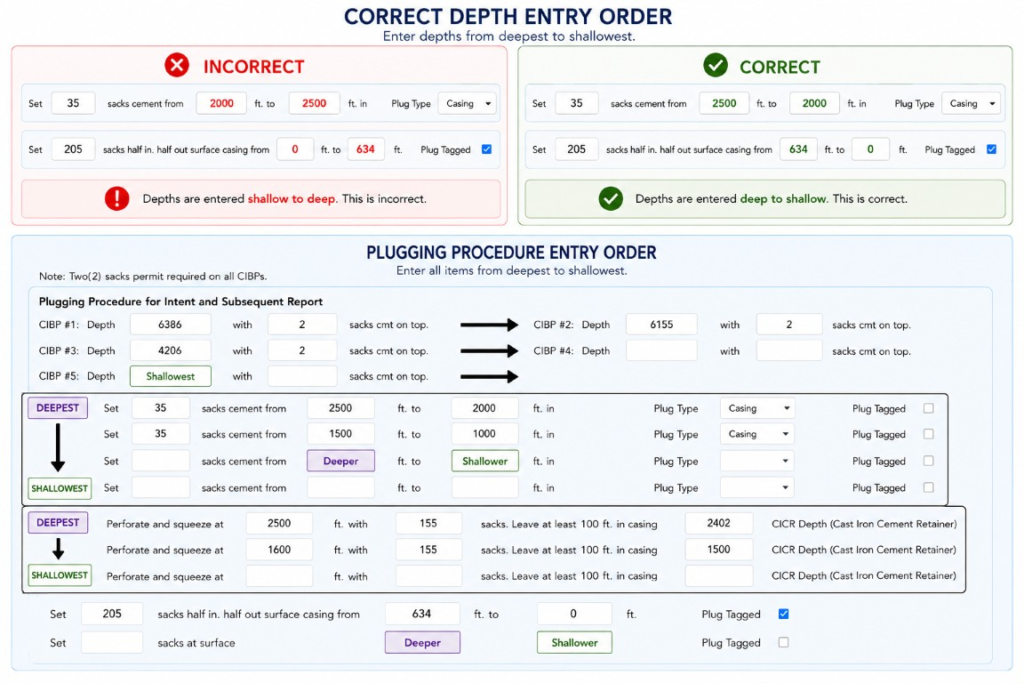
Inconsistencies between the Form 6, wellbore diagrams, historical well information (Form 5 and Form 5A), and the proposed plugging program. Two common examples: depths on the wellbore diagram that differ from historical reporting by a few feet, and depths on wireline and cement tickets that don't agree with each other. Either forces the reviewer to stop and reconcile the record.
Insufficient technical detail
Not enough detail to clearly establish the proposed plugging method — for example, a missing plug or a plug that fails to meet ECMC Rule 434.a, which requires any cement plug to be a minimum of 100 feet in length and extend a minimum of 100 feet above each zone being isolated.
Missing or incomplete attachments
Including third-party tickets with typo-level depth errors that contradict the rest of the package.
Disconnects between the approved NOI and field execution
These become particularly important when preparing the SRA.
Unaccounted site-specific or well-specific conditions
Including locations that fall within a wildlife habitat High Priority Habitat (HPH)
requiring consultation or specific BMPs for sensitive areas.
Form 7 reporting that isn't up to date with the proper well status
Form 7, the Monthly Report of Operations, the Monthly Report of Operations, is due 45 days from the last day of the month the well was plugged. From the month the well was plugged, the status should be reported as PA (plugged and abandoned), and the following month must also be reported as PA. Two examples of how this goes wrong:
- A well is plugged and abandoned in April; April's Form 7 shows PA, but May's shows TA. May needs to reflect PA.
- Only one month of production reporting shows PA when two consecutive months are required.
If the well produced or injected during the month it was plugged, the Form 7 should report PR or IJ volumes for the number of days the well was active, with the following month reported as PA. Form 7 reporting is also required to continue (as PA) until all fluid inventory is moved off-site.
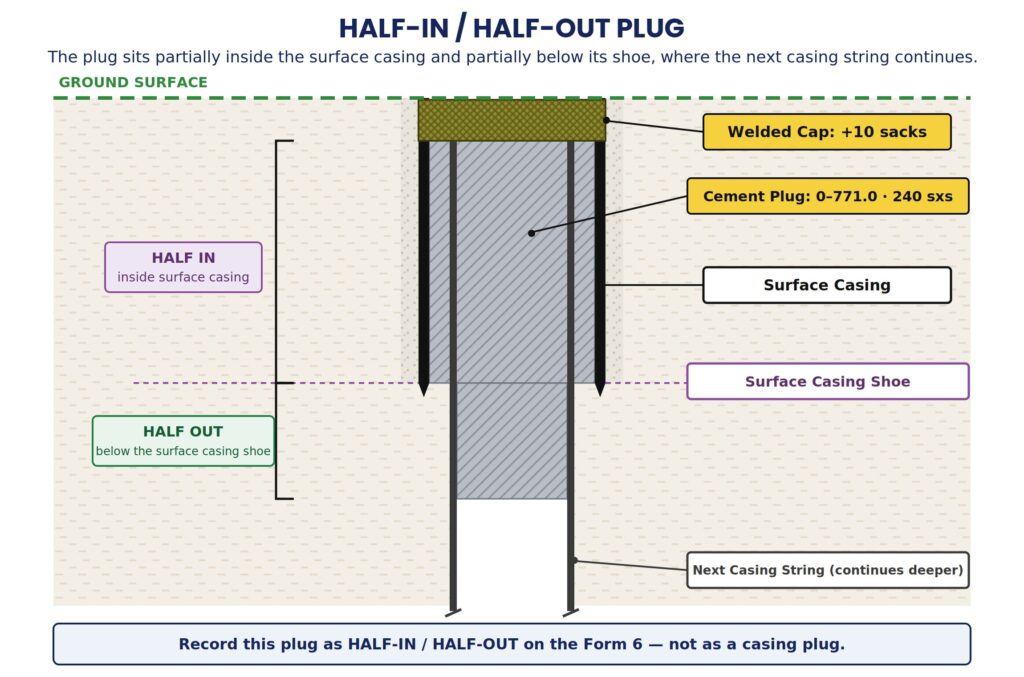
Reporting incorrect plug types
A common example is a half-in/half-out plug recorded as a casing plug. When casing is cut and a plug sits partially in open hole and partially inside surface casing, it should be recorded on the form as a half-in/half-out plug.