
Understanding the Requirements Behind Accurate Federal OGOR Production Reporting (ONRR).
By: Rebecca Long (Trujillo) |Last updated: August 27, 2026
OGOR reporting is rarely a problem in the month it is filed. It becomes a problem months later, when a misplaced measurement point or a carried-forward inventory has quietly grown into a reporting history nobody has reviewed.
The Oil and Gas Operations Report (OGOR) is the monthly production report that upstream operators submit to the Office of Natural Resources Revenue (ONRR) for wells on Federal and Indian leases. It gives ONRR detailed information about production, disposition, inventories, and well operations associated with each Federal or Indian lease agreement, and per 30 CFR § 1210.103 it is due by the 15th day of the second month following the month of production. The OGOR has three sections, OGOR-A, OGOR-B, and OGOR-C, which must reconcile to the oil, gas, and water volumes reported for the lease or agreement.
For operators producing on Federal and Indian leases, OGOR reporting is an important part of maintaining accurate federal reporting and royalty compliance. While it may look like another monthly production reporting requirement, accurate OGOR reporting is much more than submitting production volumes. It requires an understanding of how production moves from the well through the lease and ultimately to the point where it is measured, sold, or placed into inventory.
ONRR and the Bureau of Land Management (BLM) are both part of the U.S. Department of the Interior, with complementary responsibilities for Federal and Indian oil and gas development. BLM oversees leasing, permitting, measurement points, and operations on Federal and Indian lands, while ONRR is responsible for collecting and managing the revenues owed to the Federal government, Tribes, and Indian mineral owners. Because those responsibilities are interconnected, accurate OGOR reporting depends on understanding the relationship between regulatory requirements, lease operations, measurement points, and production reporting.
Why does OGOR reporting become a challenge for operators?
For many upstream operators, OGOR reporting is handled alongside monthly production accounting, revenue processing, and other operational responsibilities. When reporting is accurate and the underlying data is well understood, the process becomes routine. Issues arise when reporting responsibilities change hands, production accounting systems are modified, assets are acquired or divested, or historical reporting has never been thoroughly reviewed.
Those issues can surface as delinquent reports, historical reporting discrepancies, ONRR Orders to Report, or ONRR Preliminary Determinations that require the operator to take a much deeper look at how production has been reported.
Federal production reporting also differs from the production reporting requirements of state regulatory agencies. Understanding those differences is one of the first steps toward accurate OGOR reporting.
Where is production reported on the OGOR?
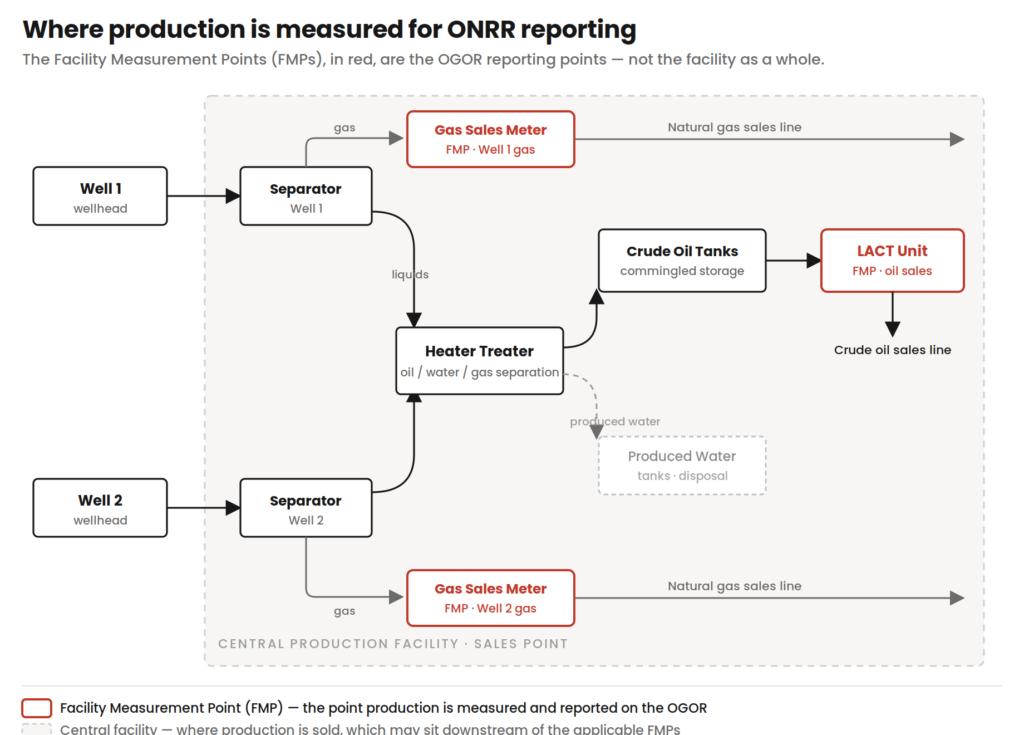
One of the most important concepts for an operator reporting to ONRR is the location of the 43 CFR § 3173.12 Facility Measurement Point (FMP).
State production reporting is generally based on where production leaves the lease or where custody transfer occurs. Federal reporting requires the operator to understand where the applicable FMPs are located and how those measurement points relate to the Federal or Indian lease agreement. That distinction creates reporting challenges when production from multiple wells, pads, or lease agreements flows to a common downstream facility.
For example, an operator may have wells producing from a Federal lease agreement where the oil and gas flows to a centralized facility that also handles production from other wells and potentially other lease agreements. The central facility may be where the operator sells its production, but the applicable FMPs for ONRR reporting may sit further upstream, such as at wellhead separator meters. Assuming the central sales facility represents the Federal lease for OGOR purposes can result in production being reported incorrectly.
This is why communication between Production Accounting, Regulatory, Land, and Field Operations matters. The production accounting analyst responsible for the OGOR may not have the regulatory documentation needed to determine where the applicable FMPs are located. Reviewing the facility diagram submitted to BLM and understanding how the lease is configured provides the information needed to report production correctly.
How does the OGOR report work?
The OGOR is divided into three sections. Each serves a different purpose, but the three parts work together and must reconcile to the oil, gas, and water production volumes reported for the lease or agreement.
| OGOR-A | OGOR-B | OGOR-C |
|---|---|---|
| What it reportsOperations by well and producing interval | What it reportsDisposition of OGOR-A production | What it reportsProduction held in inventory before sale |
| What it includesWell status and production volumes | What it includesSales, transfers, lease or agreement use, other movements | What it includesBeginning inventory, production, sales, ending inventory, adjustments |
| Where it goes wrongMust reconcile to OGOR-B and OGOR-C | Where it goes wrongIncorrect disposition codes, especially gas | Where it goes wrongCalculated inventories that carry forward |
Understanding how production moves from the lease to the FMP and downstream facilities is critical when determining the appropriate disposition codes on OGOR-B. And because OGOR-C carries inventory from one reporting period into the next, an error in one month can create a continuing discrepancy in every reporting period that follows.
What are the most common OGOR reporting issues?
In Progressive Consulting's experience, the most significant reporting issues occur on OGOR-B and OGOR-C.
Incorrect disposition codes on OGOR-B
OGOR-B issues typically occur when incorrect disposition codes are used, particularly when reporting gas and understanding how gas moves downstream. Operators may need to determine whether gas is subject to a direct sale under a Percent of Proceeds (POP) contract, whether gas is returned to the lease for fuel use and is therefore treated differently for royalty purposes, or whether drip, retrograde, or pipeline condensate needs to be allocated back to the applicable lease or agreement.
ONRR guidance should always be reviewed when reporting circumstances are complex or when specific reporting requirements change. In September 2024, for example, ONRR issued a Dear Reporter letter on Gas Production and Drip Condensate Guidance. Drip condensate may be recovered from gas pipelines or transportation facilities downstream of the applicable FMP, which raises questions about how those volumes should be reflected on the OGOR.
This is one reason Progressive recommends that operators regularly review ONRR Dear Reporter letter and other reporting guidance. These communications clarify specific reporting requirements and help operators identify changes that may affect their reporting.
Calculated inventories on OGOR-C
Another common issue Progressive encounters when taking over production reporting responsibilities or performing historical reporting audits involves oil tank inventories. Accurate inventory reporting is critical because beginning inventory, production, sales, and ending inventory must reconcile. The problem starts when an analyst begins calculating ending inventory rather than using the actual tank gauge to establish it.
In a simplified production accounting calculation, the known values are used to determine production:
When production calculations do not reconcile, an analyst may instead begin calculating the ending inventory:
The second calculation produces an ending inventory balance, but a calculated inventory rather than the actual physical tank gauge causes discrepancies to carry forward from month to month. Those discrepancies become particularly significant during an ONRR or BLM audit. When auditors compare OGOR-reported inventories against actual tank inventories throughout the audit period, historical discrepancies may require the operator to review and correct months or even years of OGOR reporting.
Validating inventory reporting and understanding how production calculations are generated within the production accounting system is an essential part of maintaining accurate OGOR reporting.
Why does a proactive OGOR review prevent larger problems?
OGOR reporting issues are much easier to identify and correct before they become the subject of an ONRR Order to Report, Preliminary Determination, or audit. A proactive review helps operators identify discrepancies in production volumes, dispositions, FMP reporting, inventories, and historical data while there is still an opportunity to investigate the underlying cause and make appropriate corrections.
Progressive Consulting works with operators to navigate the complexities of ONRR OGOR reporting, production accounting, regulatory compliance, and historical reporting cleanup. The goal is not simply to correct an individual reporting issue, but to help operators understand the underlying cause and establish more reliable reporting going forward.
Accurate Federal production reporting begins with understanding how the lease is configured, where production is measured, how product moves, and how that information flows through the production accounting system into the OGOR.
Questions worth answering before ONRR asks them for you
- Do you know where the applicable FMPs are located for every Federal and Indian lease agreement, and does the facility diagram on file with BLM match how the lease is actually configured?
- Where production from multiple wells or lease agreements flows to a shared central facility, is production reported at the upstream FMPs rather than the sales point?
- Do OGOR-A, OGOR-B, and OGOR-C reconcile to the oil, gas, and water volumes reported for each lease or agreement every month?
- Are ending oil inventories on OGOR-C taken from actual tank gauges, or has the production analyst started calculating them?
- Are gas dispositions on OGOR-B coded correctly for POP contract sales, gas returned to the lease for fuel, and drip, retrograde, or pipeline condensate allocated back to the lease?
- Have recent ONRR Dear Reporter letters been reviewed against your current reporting practices?
- When reporting responsibilities, production accounting systems, or assets changed hands, was the historical reporting reviewed?
- Could you support every reported inventory with a gauge record if ONRR or BLM asked for the audit period?
When is the OGOR reporting due?
OGOR reports are due by the 15th day of the second month following the month of production. Production reported for January, for example, is due to ONRR by March 15.
Meeting the monthly deadline avoids delinquent reporting and potential compliance issues. Operators should also leave sufficient time before the deadline to review production volumes, dispositions, inventories, and other reporting data for accuracy.
When will ONRR or BLM audit my leases?
There is no fixed schedule for when an operator or lease agreement will be selected for an ONRR or BLM audit. An audit may focus on a limited period for a single lease agreement or expand to multiple lease agreements and several years of reporting history.
Because operators may not know when their leases will be selected for review, maintaining accurate and supportable production and royalty reporting on an ongoing basis reduces the risk of significant issues being identified during an audit.
Is there a statute of limitations for ONRR audits?
Generally, ONRR's audit authority is subject to a seven-year limitation period for Federal leases. Different rules can apply to Indian leases, where ONRR may be able to review reporting and royalty information for the entire life of the lease agreement.
Because the applicable lookback period depends on the type of lease and the circumstances involved, operators should not assume that older reporting is outside the scope of a potential review. For operators with historical reporting concerns, a proactive review can identify discrepancies and determine whether corrective reporting is appropriate before an ONRR or BLM audit identifies the issue.
How Progressive supports Federal ONRR Filings
Progressive has 25+ years of experience supporting oil and gas operators of all sizes with Federal ONRR production reporting. Progressive has prepared and submitted ONRR Filings and has extensive experience responding to ONRR comments, navigating revisions, and audits. Our team understands Federal ONRR regulatory expectations as well as the field and technical requirements that must be reflected in a complete and defensible submittal.
See our Production Accouting Services page for more details on how we can help your team.
That combination of regulatory knowledge and production accounting experience allows Progressive to identify potential issues before they become filing delays — and helps operators move projects forward with greater confidence.
Talk to our Production team