
Correcting Historical OGOR Inventory Discrepancies During a Production Accounting System Upgrade
By: Rebecca Long (Trujillo), Production Manager | Last updated: October 2026
- Client
- Upstream operator, Greater Green River Basin (Wyoming)
- Scope
- Hundreds of Federal lease agreements; ONRR OGOR reporting
- Challenge
- Calculated ending inventories didn't match actual tank gauges and had carried forward for about 6 months on each affected lease
- Services
- System setup review, historical cleanup, OGOR corrections, monthly close support
- Result
- Historical reporting corrected to current month; revision files delivered to Revenue; ongoing reporting deadlines maintained
- Team
- Two analysts: one on monthly close, one on historical cleanup
An unexpected discovery
Progressive was engaged by an operator with hundreds of Federal lease agreements in Wyoming's Greater Green River Basin. The initial assignment was to update production accounting system setups after a software upgrade, since existing processes no longer ran efficiently in the upgraded system. Progressive also supported the operator's regular monthly close and reporting.
During the first monthly close, Progressive compared the prior month's final allocation file with its new inventory validation checks. Reported ending inventories didn't match the balances the new checks calculated.
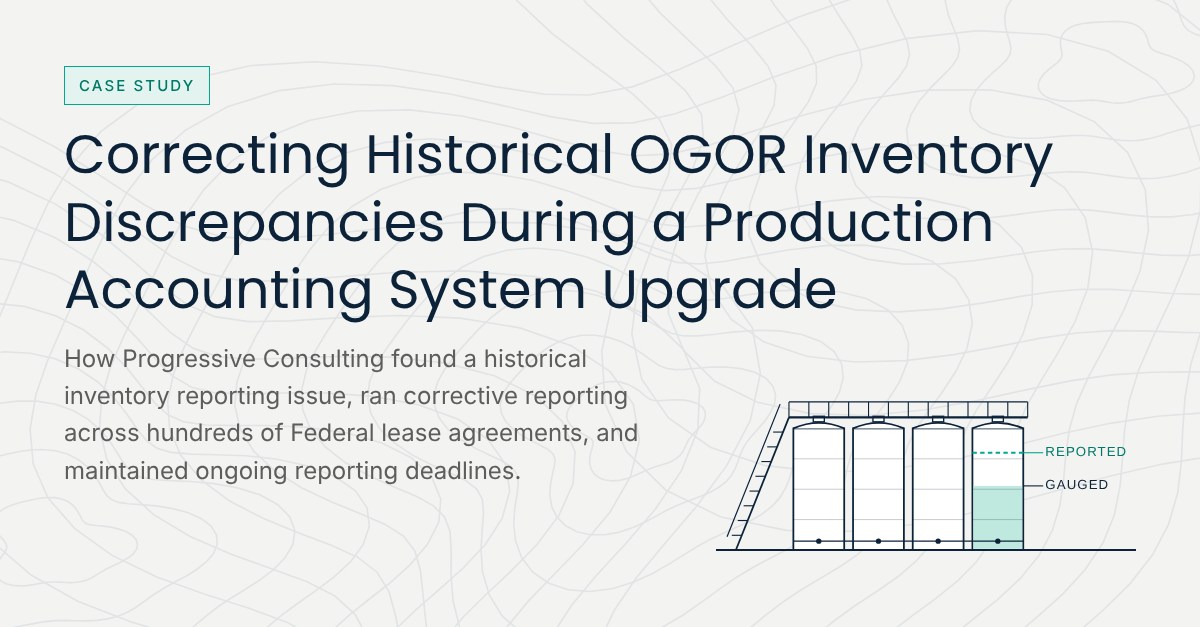
Digging further, the ending inventories in the allocation files matched what was being reported on the Oil and Gas Operations Reports (OGORs) submitted to ONRR. But those balances did not match the actual ending tank gauges Lease Operators had entered in the production accounting system.
At some point, ending inventories had begun to be calculated rather than taken from actual tank gauge measurements. The practice started as a workaround for production calculation issues, including inventory decreases that produced negative calculated production.
A calculated ending inventory can balance mathematically and still not reflect what's physically in the tank.
As those calculated balances carried forward month to month, the discrepancies accumulated and affected historical production reporting. A system improvement project had turned up a historical issue spanning multiple wells and Federal agreements.
Finding the scope of the problem
Before correcting anything, Progressive had to establish when the calculation practice began, which agreements it touched, and how far back the discrepancies ran. That meant reviewing prior reporting periods to find where reported inventories first diverged from tank gauges. Of the 502 Federal leases reviewed, 57 had inventory issues.
Meanwhile, the operator's monthly close and state and Federal reporting deadlines still had to be met. Historical cleanup could not come at the expense of current obligations.
A structured cleanup plan
Progressive built a tracking process for the affected wells and agreements, documented each inventory issue, and managed corrective reporting from the point each discrepancy began through the current month. Leases were worked systematically rather than all at once, with a goal of three to six per month.
- 1
Identify and correct historical discrepancies
Research the affected periods and correct reporting from where each discrepancy began through the current reporting month, typically about six months of OGORs per lease.
- 2
Maintain ongoing reporting deadlines
Keep routine monthly close and state and Federal reporting on time throughout the cleanup.
- 3
Coordinate production and revenue updates
Deliver revision files to the operator's Revenue team to review any sales impacts from the corrected production and inventory data.
Two analysts, two jobs, one plan
Progressive assigns at least two analysts to a client when the scope warrants it. Here, that let current reporting and historical cleanup move forward at the same time.
Monthly close & reporting
Kept current-month allocations and state and Federal filings on schedule.
Historical cleanup
Researched affected periods and prepared corrective reporting.
The two worked closely to share findings and make sure historical corrections lined up with ongoing reporting.
More reliable inventory and production reporting
Over about nine and a half months, Progressive resolved the inventory discrepancies on all 57 affected leases, corrected historical reporting from the point the issues began through the current period, and delivered revision files to the Revenue team.
The engagement shows the value of validating the data behind system outputs instead of assuming an established process is producing accurate results. Because inventory carries forward, an issue that looks isolated can reach across many reporting periods.
Production accounting and OGOR support
Historical discrepancies don't always surface in an audit. They often show up during a system upgrade, a process change, or routine monthly close.
- Production accounting system setup reviews and process improvements
- Historical production and inventory reporting cleanup
- OGOR reporting reviews and discrepancy resolution
- Coordination of revised production reporting and related revenue impacts
- Ongoing monthly close and state and Federal reporting support
OGOR inventory questions
What causes OGOR inventory discrepancies?
A common cause is ending inventory being calculated to force a balance instead of taken from actual tank gauges. The calculated figure then carries into the next month's beginning inventory, and the error compounds.
How far back do OGOR corrections need to go?
Corrections generally start from the first period where reported inventory diverged from actual measurements and run through the current month, since each month's beginning inventory depends on the prior month's ending balance. In this engagement, that meant about six months of OGORs per affected lease.
Can historical cleanup happen without disrupting monthly reporting?
Yes, with dedicated staffing. Splitting monthly close and historical correction between analysts keeps current deadlines on track while the cleanup proceeds.
Seeing numbers that don't tie out?
Talk to our production accounting team about a reporting review.